Congratulations, Achim! How do you feel about receiving this prize?
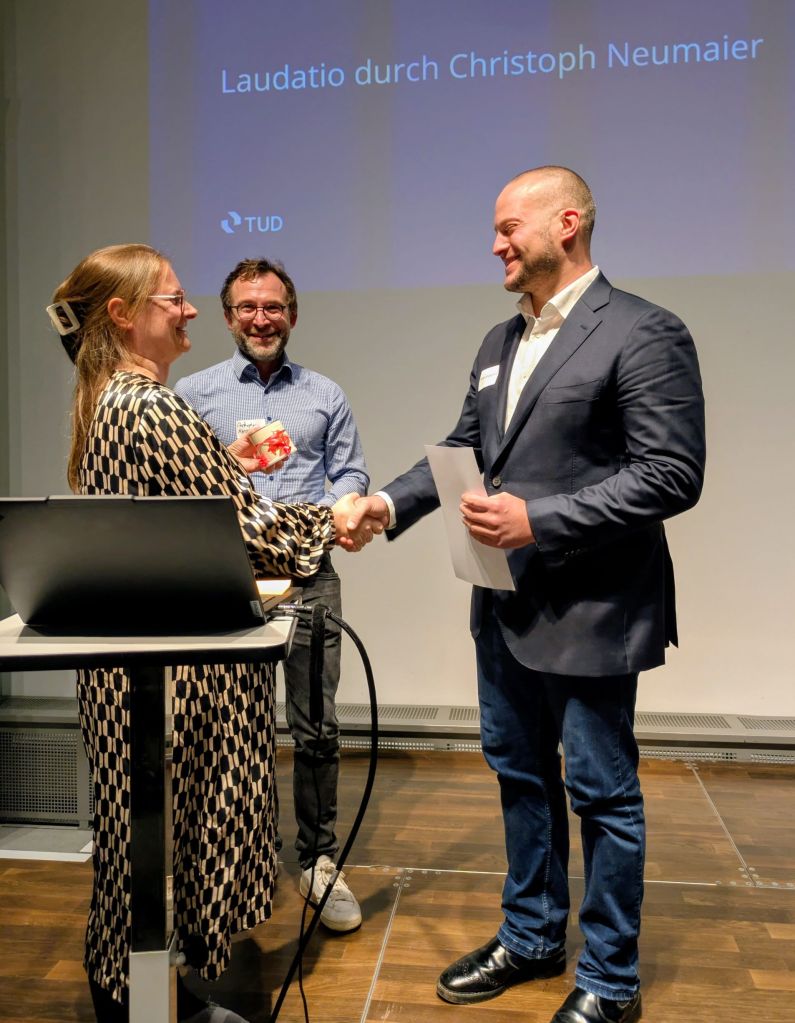
I’m very happy for this recognition of my work, and especially that the members of the prize committee have actually read and engaged with my article. There was a prize ceremony on the occasion of the annual conference of the Gesellschaft für Geschichte der Wissenschaften, der Medizin und der Technik (GWMT), held in Dresden in Germany earlier this autumn. Professor Christopher Neumaier, who headed the prize committee, gave a “laudatio”, explaining why the committee appreciated my article, and I felt humbled and very happy.
Your article examines the early history of the Chernobyl nuclear power plant. Isn’t it strange that so few scholars have done so before?
It’s true that most research on Chernobyl deals with the drama of the accident itself and its tragic aftermath, whereas the early history of the plant has been much less explored. Maybe it is not considered dramatic enough? My article deals to a great extent with “boring” aspects of nuclear construction, including things like leaking water pipes, faulty staircases, and the pouring of concrete. But I’m convinced that we need to study exactly these aspects, as they may reveal deeper structural issues and even lead us to find some parallels to our own societies.
How did you manage to carry out this research at a time of pandemic and war?
It was tough, but I was lucky, because I first managed to visit central Soviet archives in Russia in 2019. Then, in the midst of the pandemic, thanks to generous ERC funding for our project and smooth cooperation with our university library at KTH in Stockholm, I was able to access valuable digitized sources on Chernobyl’s early history including local newspapers and KGB files. When the pandemic receded I was able to travel to Kiev and visit several archives there in autumn 2021. This turned out to be tremendously fruitful and I could probably not have written my article in the absence of those archival sources. The everyday aspects of the story, in particular, would have been much weaker. But I was just in time, because only four months later Russia launched its full-scale invasion of Ukraine and it became impossible to consult Ukrainian archives on site.
What are you especially proud of when it comes to this article?
I’m especially proud of my analytical approach, which is based on the concept of technocratic culture. As I see it, this approach partly explains why the Chernobyl accident happened, and it adds a novel perspective to the literature. I argue that actual Soviet reactor safety was the result of everyday decisions, and that these decisions were taken in a political system that forced actors to cut corners and speed up things in a dangerous way. It’s important for me not to blame the workers. The problem was that the workers could not do their job properly within the framework of the system.
We’re excited to announce that our edited volume The Nuclear-Water Nexus is finally out with MIT Press since a few days! This happens just as multiple nuclear power plants in continental Europe are once again forced to shut down partly or completely due to the current heatwave – a stark reminder of nuclear energy’s intricate envirotechnical entanglements and dependence on cooling water supplies.
It has been fantastic for us – Per Högselius and Siegfried Evens – as editors to work on this book during the past three years together with our 25 contributing authors: Diego Sesma-Martín, Mar Rubio-Varas, Elisabetta Bini, Achim Klüppelberg, Tom Turnbull, Max Lau, Jan-Henrik Meyer, Sonali Huria, Kumar Sundaram, Anaël Marrec, Carlos Gonzalvo, Heather Williams, Joanna Dyl, Roman Khandozhko, Elizabeth Hameeteman, Duygu Sever, Victor McFarland, Peter Burt, Sarah E. Robey, Sabine Loewe-Hannatzsch, Agnès Villette, Jonathon Turnbull, and Kate Brown.
If you are interested in the problem of riverine nuclear power plants during heatwaves, you may also want to read a recent article that NUCLEARWATERS researchers Alicia Gutting and Per Högselius just published together with Patricia Burkhardt-Holm in Energy Policy: https://www.sciencedirect.com/science/article/pii/S0301421525001387
On Tuesday 11 June NUCLEARWATERS project member Alicia Gutting successfully defended her PhD thesis at KTH Royal Institute of Technology, entitled “The Nuclear Rhine: Conflict and Cooperation in a Transnational River Basin.” Alicia has been a doctoral student at the Division of History of Science, Technology and Environment since October 2018, devoting herself to the exploration of nuclear energy along the Rhine and the Aare.
Alicia Gutting’s dissertation exemplifies how the water and nuclear energy sectors are intricately and interdependently entwined. The relationship between water and nuclear energy is being examined specifically in the Rhine River basin from the 1950s to the contemporary period. In a longer introductory essay and four separate research articles, the thesis scrutinizes the complex interaction between nuclear development and water management in riverine settings. The study gains particular relevance in the context of climate change, which heightens the environmental impact of nuclear power plants that source their cooling water from rivers and the vulnerability of such plants to extreme weather events, such as heatwaves. Employing a transnational and interdisciplinary approach, Alicia’s research challenges conventional national narratives and underscores the significance of cooperative and shared resource management along the Rhine.
Two of the four articles have already been published:
The two other articles are available in preliminary form only, as they are still in the publication process.
Jan-Henrik Meyer and Alicia Gutting
At the public PhD defence, we were delighted to that Jan-Henrik Meyer from the Max Planck Institute for Legal History and Legal Theory accepted our invitation to serve as the faculty opponent. The examination committee consisted of Zahra Kalantari from KTH’s Water Centre, Elisabetta Bini from the University of Naples Federico II and Stephen Milder, who is currently at the Rachel Carson Center in Munich. Lize-Marie Hansen van der Watt, in her capacity as chairperson, moderated the event. The defence was followed by a reception at the Division of History of Science, Technology and Environment.
The NUCLEARWATERS project continues to deliver essential research results. This was showcased on Friday 3 May, when Siegfried Evens, a doctoral student in the project, successfully defended his PhD thesis on the history of nuclear safety seen through the lens of water.
The dissertation, entitled “Streams, Steams, and Steels: A Transnational History of Risk Regulation in Nuclear Power Plants (1850–1985)”, starts out from the observation that the technologies that enable water and steam to circulate in nuclear power plants – pressure vessels, steam generators, pipes, valves, and pumps – have been much neglected in earlier research on the history of nuclear energy. Siegfried’s PhD thesis seeks to counter this by studying how national and international actors have historically regulated the risks linked to these crucial reactor components and materials.
Relying on archival sources from the US, France, Sweden, and multiple international organizations, as well as on interviews, the dissertation develops a new, longue-durée history of nuclear safety, going back to the origins of water and steam risk management in the nineteenth century. Such a historical perspective on nuclear risk regulation reveals two important insights. Firstly, in the 1950s and 1960s, the usage of water and steam technologies in nuclear reactors revealed new types of risks. These “ambi-nuclear risks,” as Siegfried calls them, are a hybrid of older steam risks, such as leaks, breaks, and explosions, and new risks of radiation and contamination. Secondly, between the 1950s and 1980s, new regimes were created in the US, France, and Sweden to regulate these risks. Initially, during the 1950s, non-nuclear steam regulations were applied directly to the first nuclear power plants. Yet, as power plants increased in size, accidents occurred, and nuclear technologies became increasingly controversial, “ambi-nuclear risk regimes” were created to adapt or “nuclearize” the older regulations. They included new safety measures and methodologies that were directed toward preventing radiation releases, but at the same time they mobilized older technologies, institutions, knowledges, and ideas related to thermal hydraulics and metallurgy. Ambi-nuclear risk regimes were shaped by a wide variety of historical actors through negotiating boundaries between “nuclear” and “non-nuclear” knowledges, components, risks, and regulations. Private or semi-private engineering associations played a particularly vital role in this.
Siegfried Evens’ thesis thus shows how nuclear safety as we know it today became nuclear as the result of a transnational long-term process that was greatly determined by much older non-nuclear water and steam risks. The research results contribute to ongoing scholarly debates on risk, nuclear technologies, and water in fields like history of technology, environmental history, STS, and risk sociology. Most importantly, the thesis expands the time frame in which nuclear risk has traditionally been studied. It challenges dominant conceptions of nuclear power as innovative or exceptional, instead connecting questions of nuclear risk to longer historical developments in water management and industrialization. This demonstrates the importance of historical contingency for understanding risk and preventing (nuclear) disasters.
Scott Gabriel Knowles and Siegfried Evens during the defense (Photo by Per Högselius)
We were very happy that Prof. Scott Gabriel Knowles from the Korea Advanced Institute of Science & Technology (KAIST), a leading expert on the history of disasters, accepted our invitation to be the faculty opponent. We were equally pleased to have Prof. Maria Rentetzi from the Friedrich-Alexander-Universität Erlangen-Nürnberg, Prof. Thomas Wellock from the US Nuclear Regulatory Commission, and Dr. Anna Åberg from Chalmers University of Technology in the examination committee.
The defense, which took around 3½ hours, was followed by a reception at the Division of History of Science, Technology and Environment, and later in the evening by a party that, fittingly, took place in the R1 Reactor Hall at KTH, where Sweden’s first nuclear reactor was started up back in 1954.
Celebrating the successful PhD defense in KTH’s R1 Reactor Hall (Photo by Siegfried Evens)
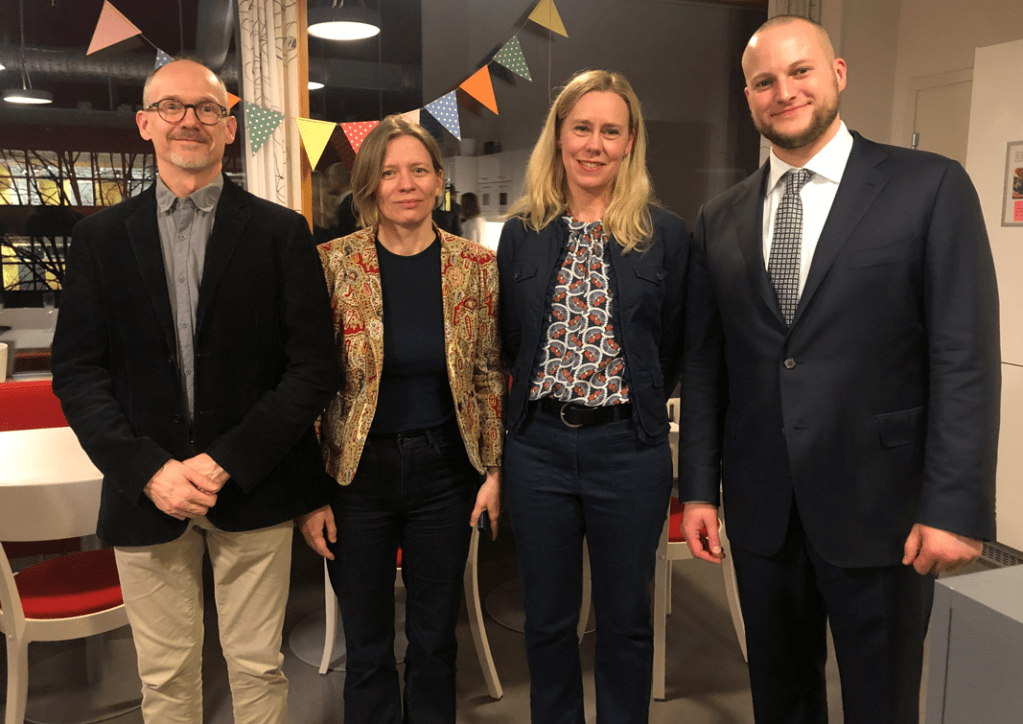
The respondent with proud supervisors after the defence. From left to right: Per Högselius, Kati Lindström, Anna Storm and Achim Klüppelberg (Photo by Florence Fröhlig)
Achim has been a doctoral student at the Division of History of Science, Technology and Environment at KTH Royal Institute of Technology in Stockholm since October 2018, and his PhD thesis is an integral part of the NUCLEARWATERS project. The thesis is a “compilation thesis”, consisting of a longer introductory essay and six separate texts, of which one is a book manuscript and five take the form of shorter articles:
The Soviet Nuclear Archipelago: A Historical Geography of Atomic-Powered Communism (co-authored with Per Högselius)
“Completely Original and Progressive”. How Gidroproekt Combined Hydraulic and Nuclear Expertise at the South Ukraine Energy Complex
Joining the Dnieper Cascade. An Envirotechnical Water-History of Chernobyl Nuclear Power Plant, 1950–1986
Creating Chernobyl. Technocratic Culture and Everyday Life in Nuclear Ukraine, 1970–1982
Water, Fish, and Contamination in Chernobyl’s Cooling Pond
A Fishy Tale of the Nuclear Power Plant Never Built in Estonia. An Envirotechnical History of Energy, Fish, Land and Water Resources Planning at Lake Võrtsjärv (co-authored with Kati Lindström)
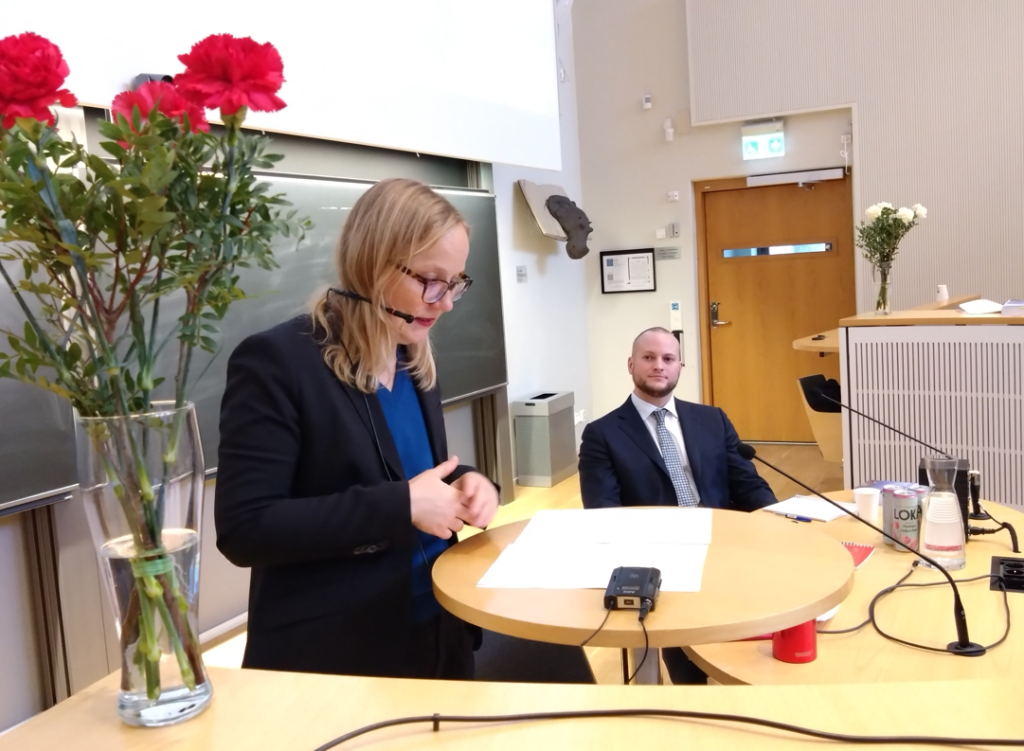
Prof. Melanie Arndt and Achim Klüppelberg during the thesis defence (Photo by Per Högselius)
We were delighted that Melanie Arndt from the Albert-Ludwigs-Universität Freiburg in Germany accepted our invitation to act as the faculty opponent. Melanie, who is professor of economic, social, and environmental history and has published extensively on Chernobyl, did a fantastic job in presenting and critiquing the 500+ pages of Achim’s PhD thesis. Then the examination committee, consisting of Florence Fröhlig from Södertörn University, Laurent Coumel from the Institut national des langues et civilisations orientales in Paris, and Viktor Pál from the University of Ostrava, showered the respondent with additional questions for about one hour. Several people in the audience commented that the defense was unusually stimulating, and expressed their admiration for Achim’s ability to calmly respond to and discuss all issues raised.
After the formal event and the examination committee’s unanimous decision to give the thesis a “pass” (in the Swedish system there is only a pass/fail grading), all guests were invited for a lively reception at the Division of History of Science, Technology and Environment.
As the NUCLEARWATERS project, after six years, is approaching its official end, we are excited to be able to release a stream of research results in the form of scholarly publications. This week we are happy to announce the publication of a new special issue. It appears in the interdisciplinary journal Historical Social Research (HSR) and has as its overarching theme “Geographies of Nuclear Energy in Past and Present.”
This publication project has its origin in a double session organized by NUCLEARWATERS researcher Alicia Gutting and project leader Per Högselius back in September 2021 at the annual international conference of the Royal Geographical Society and the Institute of British Geographers (RGS-IBG). There were 12 paper presentations at the conference, 8 of which were eventually turned into journal articles for the special issue. One more intriguing paper, written by Christian Götter, was subsequently added, based on a presentation held at the European Society for Environmental History (ESEH) meeting in Bern last summer. In its final, published version, the special issue includes the following 10 contributions:
Christian Götter: Accepted to Cool: Conflicts about Cooling Technologies for Riverside Nuclear Power Plants.
Louis Fagon: Who Is Affected? Defining Nuclear Territories and Their Borders: A Historical Perspective on the Nuclearization of the Rhône River from the 1970s to the 1990s.
Jan-Henrik Meyer: Nuclear Power and Geography: How the European Communities Failed to Regulate the Siting of Nuclear Installations at Borders in the 1970s and 1980s.
Melanie Mbah & Sophie Kuppler: Governing Nuclear Waste in the Long Term: On the Role of Place.
Teva Meyer: Bordering Nuclearity: Very Low-level Radioactive Wastes’ Clearance and the Production of Spatial Nuclearities in Germany.
Not all articles are available open access at the moment, but you can access the two NUCLEARWATERS contributions using the links above and the rest by contacting the respective authors.
2023 was a turbulent year for me. I am grateful for many great experiences that helped me to grow as a novice scholar and as a person. In the following I would like to reflect in a few paragraphs on this past year. But before I start: Merry Christmas and happy end-of-the-year holidays to everyone! I hope you will have a marvellous New Year’s Eve and that you will find the strength to follow up on your new year’s resolutions.
My 2023 started unconventionally as I stayed for six weeks in Darmstadt, a city with 180,000 inhabitants near Frankfurt in Western Germany. As a visiting scholar at the Technical University’s Division for History of Science, led by Martina Heßler, I was able to discuss our work in a new environment and to pick up new theoretical insights of relevance for my dissertation. I also found new (and old) friends there, which was great. The stay certainly also helped to keep the connection between Darmstadt and our own division at KTH alive.
On 20 March 2023 it was time for my final seminar (80%) of my doctoral education. Eglė Rindzevičiūtė from Kingston University in London travelled from the United Kingdom to Stockholm to discuss the development of my dissertation. This seminar was a key event in my education at KTH and it helped me to improve my text tremendously. Following this seminar I regrouped and then created a plan for finishing the dissertation. A plan that later had to be revised.
In 2023 I presented my research in Darmstadt (Germany), Tübingen (Germany), Bern (Switzerland), and at different venues in Stockholm. As always, presenting helps to sharpen the arguments and the feedback from the audience supports the writing process. Personally, I enjoy public speaking and while these events were stressful, they were all very rewarding.
From spring until the end of 2023 I also acted as the PhD representative at our Department of History and Philosophy at KTH. This was a new experience for me on a doctoral level of student administration; a responsibility I at first did not want to take over but eventually fit in reasonably well.
As 2023 was coming to a close, the writing and finalisation process of my dissertation took over all my work. Slowly I finished all my teaching responsibilities and focussed on improving the “kappa” (the introductory essay) and the individual articles. In the end, the writing took longer than we previously planned. Nevertheless, the defence is now scheduled for 22 March 2024. After some brief holidays, I will start again working on the dissertation on 2 January.
“Thank you” to everyone who impacted my work so positively during the past twelve months! Let’s hope 2024 will be even better, with lots of NUCLEARWATERS publications coming up.
It has been a few months since I came back from my stay in the U.S. And I have to say, I miss it sometimes. But being back in Sweden, I can reflect on the things I have learned and experienced!
I arrived in Washington, D.C. in August 2022, Typical for the summer there, the temperatures were tropical, the humidity excruciating, and the mosquitos everywhere. That is how I learned D.C. is actually a part of “The South.”
I stayed at Virginia Tech, a large technical university with a campus in the suburbs of the D.C. area. Although small and often compared to a prison or asylum, the campus had a certain charm. There were also many events for graduate students, with free food and ping-pong! It was a great way to meet other graduate students, of which most worked in engineering and computer science.
For four months, I was part of the STS Department of Virginia Tech as a guest Ph.D. student, hosted by professor Sonja Schmid. My aim was to get to know STS more and to learn from Sonja Schmid, who has worked extensively on nuclear safety and contributes actively to nuclear policy in the U.S.
One of the aims of my stay was to take part in a project-based STS graduate course. This year, the theme was ‘Nuclear Facilities in Armed Conflict.’ Together with six other American STS students, with varying backgrounds ranging from nuclear engineering to law, we wrote a policy report with recommendations on how to prevent situations like the Zaporizhia nuclear power plant in Ukraine. We also presented our work in a public session for policy-makers, government officials, and industry experts. We are working on a policy publication right now.
Washington, D.C. has many archives that are relevant for nuclear historians like me. Although they are not always easy to get into, I came back with thousands of scans from the Library of Congress, the National Academy of Sciences, the National Archives, and – most importantly – the NRC Public Documentation Room. At the NRC, I was helped a lot by the NRC historian, professor Thomas Wellock.
Staying in D.C. was a great opportunity to travel around. I attended the Society of History of Technology (SHOT) conference in the stunning city of New Orleans. I presented my work in the college town of Blacksburg, where the main campus is located, and received great feedback from the STS scholars there. And in an act of ‘dark tourism’, I drove up to the Three Mile Island nuclear plant, which is only a two-hour drive away from D.C.
But after each trip, I was also happy to be back in D.C. It is a marvelous place to live. Paradoxically, the capital of the U.S. has a very European feel: wide sidewalks, beautiful architecture, good public transport, lush parks, and so many great pubs and restaurants. I lived in Columbia Heights, a beautiful historic area with small row houses built after the Civil War to house new civil servants.
Yet, at the same time, the abundance of museums, monuments, and sports stadiums – but at the same time also the stark racial social inequalities in the city – remind you of American history and culture every day. American politics is never far away either: when you talk to people, see politicians or “staffers” in the streets, or when walk on the National Mall and cannot get the intro tune of House of Cards out of your head.
As the NUCLEARWATERS project is entering its fifth year, project activities continue to evolve and intensify. On 21-22 June our team organized an international workshop on the nuclear-water nexus, to which we invited senior and junior scholars from all fields – not only history – to present research that in one or the other way relates to the interaction between nuclear technologies and water. The aim was to let different research strands around this common theme interact, with the long-term goal of turning workshop papers into chapters of an edited volume. The workshop took place at our own Division of History of Science, Technology and Environment at KTH. We were happy to welcome 25 external participants from Germany, France, Spain, Italy, the United Kingdom, the United States, Canada, India, Indonesia and Qatar. A total of 28 pre-circulated workshop papers were discussed during two intense and creative days.
Plenary session at the Nuclear-Water Nexus Workshop (photo by Siegfried Evens)
The nuclear-water nexus, as interpreted by the workshop participants, turned out to be even more diverse and multifaceted that we could possibly have imagined. Themes covered in the papers and the discussions included:
1. Reactor cooling arrangements: this includes both the closed cooling loops in (water-cooled) nuclear power plants themselves, and the open cooling loops through which nuclear plants draw on water supplies from rivers, lakes and seas.
2. The links between nuclear energy, hydropower, navigation, irrigation, dam construction, and fisheries.
3. Thermal pollution of rivers, lakes, and seas as a result of cooling water discharges, and the construction of cooling towers and cooling ponds to cope with this problem.
4. The impact of nuclear accidents, nuclear weapons testing and radioactive pollution on drinking water supplies and wet environments and landscapes.
5. Wet pollution (such as oil spills) and organic matter (fish, jellyfish, algae, etc.) as a threat to nuclear safety.
6. Flooding of nuclear facilities and flood management strategies, along with destructive erosion at coastal nuclear sites
7. The use of nuclear energy for the purpose of seawater desalination and for district heating
All in all, the Nuclear-Water Nexus workshop became one of the intellectually most fruitful activities so far in the NUCLEARWATERS project. We are looking forward to the continued work with an edited volume, based on the workshop papers – and perhaps other outcomes of the workshop as well.
There was a time when virtually all my academic activities gravitated around the Baltic Sea. For a number of years, I travelled along its coasts, attempted to learn its languages and read everything I could find about its history. I spent a year and a half in Greifswald in Pomerania, where I wrote my master’s thesis, then a year in Tallinn and Tartu in Estonia, where I did research for my PhD thesis. And of course I spent numerous summers in Kvarnåkershamn on Gotland, where we have a summer house. In 2007 I wrapped up my experiences of the Baltic Sea world in a travelogue, “Östersjövägar”, which let the past confront the present and the personal meet the professional.
Since then my geographical focus has been less distinct, as I have become engaged with wider European and global issues. The NUCLEARWATERS project, however, which aims to rewrite the global history of nuclear energy through the lens of water, has allowed me to partly return to the Baltic Sea: one of the six case studies addresses the “Nuclear Baltic”. Earlier this month I had the chance to present tentative results of it at this year’s Baltic Connections conference in Jyväskylä, Finland. I had been invited to give one of the keynote lectures, and decided to make use of the opportunity to discuss the ongoing nuclear-historical research that my colleagues at KTH and I are currently doing with a multi-disciplinary crowd of scholars from Finland, Scandinavia, the Baltics and beyond.
The notion of the “Nuclear Baltic” reflects a desire to move away from the nationally oriented nuclear histories that so far has dominated the literature and, instead, take the Baltic Sea region in its entirety as the point of departure for analysing nuclear’s past and present. There is good reason to do so, especially if we view the history of nuclear energy through the lens of water. Finland, Sweden, the Soviet Union and East Germany all built nuclear power plants on one or the other Baltic coast, making use of the same brackish water for the plants’ cooling needs. Denmark also planned to erect a Baltic nuclear plant, but eventually opted not to go nuclear at all. Poland started to built a large NPP near the Baltic coast, although in this case the nuclear builders, for reasons still not entirely clear to me, preferred to use a lake rather than the Baltic itself for cooling. Nuclear engineers tamed the Baltic Sea, adapting the coastscape to their specific needs, while the sea itself occasionally also “revolted”, causing problems for the nuclear plants. Nuclear builders, moreover, interacted intensely with fishing, navigational and recreation activities. The plants were usually built in places that were popular spots for bathing, swimming, hiking and sailing.
One of the Baltic’s nuclear power plants: The Finnish Olkiluoto NPP
After 1989, the nuclear power plants that had been erected on different Baltic shores started to interact with each other in very interesting ways. The collapse of communism on the Baltic’s eastern shores made it much easier for actors on the Baltic’s western shores to access information about nuclear developments in the east. This partly generated new fears in the West about the dangers of Soviet-designed NPPs. Finland, for example, was increasingly worried about the Chernobyl-type reactors at Sosnovy Bor. Denmark, for its part, had traditionally been extremely critical of the Swedish Barsebäck NPP, but towards the late 1980s this was more and more accompanied by fears of the Greifswald NPP as well. Sweden, too, worried both about Greifswald but even more about Ignalina and its Chernobyl-type reactors.
But there were also new hopes. The collapse of communism and the end of the Cold War opened up for new forms of hands-on technical cooperation between East and West. Nordic and West German nuclear engineers became very engaged in improving the safety of Soviet-designed plants. Moreover, the closure of the closure of the ex-GDR’s Greifswald NPP (which I have written a book about long ago) enabled engineers to take a close look at the decommissioned reactor vessels and examine safety problems related to things like pressure vessel embrittlement in Soviet-type reactors. These studies proved very useful especially for the Loviisa NPP in Finland, which had two very similar pressure vessels. The Loviisa reactors had for some time experienced embrittlement problems, and the study of the decommissioned Greifswald pressure vessels led engineers to devise effective engineering solutions to that problem. There was a similar interaction between Finland and Poland. The Poles had abandoned their work on the Zarnowiec NPP after the Chernobyl disaster. The Finns then asked the Poles if they could purchase one of the Polish reactor vessels, along with various other equipment, with the idea of using them for training purposes in Finland. These are fascinating examples of transnational dynamics in the post-Cold War nuclear Baltic.
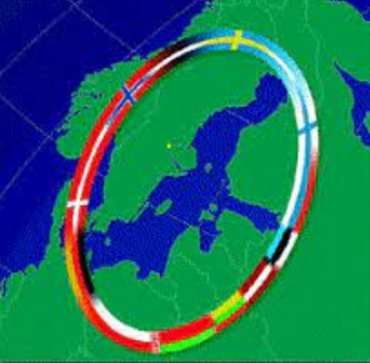
At another level, the end of the Cold War ushered in a new era of transnational cooperation in the field of electricity system-building. A mix of political and technological visionaries suggested that an integrated electricity grid and a common electricity market in the Baltic Sea region could serve as a powerful example of Baltic Sea cooperation more generally and, following a Kantian and Saint-Simonian philosophical tradition, contribute to political stability, international understanding and peace. This became the starting point a project that was popularly referred to as the “Baltic Ring”. Actors envisioned new subsea electrical connections between Finland and Estonia, between Lithuania and Poland, between Lithuania and Sweden, between Poland and Sweden, and so on – connections that would serve to unite the Baltic Sea both materially and symbolically.
The “Baltic Ring” logo
There was at least one problem with these new proposed interconnection projects: there were radically different interpretations about the actual purpose of the subsea cables. To understand this we should first observe that, for example, the Ignalina NPP in Lithuania had traditionally served electricity needs not only of Lithuania itself, but also of neighbouring regions in the ex-Soviet realm, especially Russia and Belarus. In the 1990s, then, Lithuania’s nuclear exports to these countries was expected to be phased out. In this situation, the Lithuanians hoped to compensate for its loss of export revenues by shifting its nuclear electricity exports to the Nordic region and Poland. Hence from a Lithuanian perspective the purpose of the “Baltic Ring” was to enable a restructuring of Lithuanian nuclear electricity exports. This vision contrasted starkly with Nordic and in particular Swedish visions. The Swedes regarded a potential new electricity connection between Lithuania and Sweden as a way for Sweden to strengthen the Lithuanian electricity system and, by extension, make it possible for the Lithuanians to close down their dangerous nuclear power plant. These very different interpretations was a key reason for the very long delay of the proposed link between Sweden and the Baltics; it was finally implemented only in 2015 – nearly a quarter of century after the collapse of the Soviet Union.
In the case of Poland, the decision to abandon the Zarnowiec NPP was detrimental to Polish electric grid stability. It was clear to electricity system builders that a new source of electric power was direly needed in the northern part of the country. The post-nuclear solution, however, was not to build a coal power plant or a gas power plant in northern Poland. Instead, Poland and Sweden agreed on laying down a subsea electricity cable under the Baltic Sea, through which Poland was given access to Swedish nuclear electricity. The cable, which was eventually inaugurated in 2000, landed in the port of Ustka on the Pomeranian coast, not far from the ruins of Zarnowiec. So all in all, when we read about the electricity cables that now criss-cross the bottom of the Baltic Sea, we should view them as components in a wider transnational struggle for and against nuclear energy in the Baltic Sea region.
A final chapter in the Baltic’s nuclear history has to do with how the Baltic Sea itself has gradually emerged as a threat to nuclear safety. The environmental situation in the Baltic Sea has been deteriorating for decades, in ways that the nuclear builders of the 1960s and 1970s could hardly have imagined. Since the 1980s, in particular, the Baltic Sea has seen enormous problems with eutrophication and algal blooms, much highlighted in the general media. In addition, the Soviet Union and then Russia has increased its oil exports enormously, and much of this oil is shipped through the Baltic on its way to foreign markets. These developments now pose a major threat to nuclear safety, or so nuclear engineers and power plant operators think. More precisely, what they fear is that the supply of cooling water might be compromised or disrupted for one or the other reason.
The most severely affected nuclear pant in this respect – so far! – appears to be the Finnish Loviisa facility, situated as it is in a vulnerable spot on the Gulf of Finland, where Russian oil tankers pass by and which is also susceptible to algal blooms. In response to this, the nuclear operator, Fortum, in 2013 announced a new investment program, centering on the construction of special cooling towers to “improve safety in extreme conditions when seawater becomes unavailable for cooling, such as an oil catastrophe in the Gulf of Finland, or an exceptional natural phenomenon such as excessive algae growth.” In this way the Baltic Sea, which historically seemed to offer a perfect source of cooling water, in a way that was seen to guarantee nuclear safety, is nowadays turning into a threat to nuclear safety, and nuclear engineers are now very busy devising technical solutions to cope with these perceived dangers. It remains to be seen how the marine environmental situation in the Baltic Sea continues to interact with nuclear developments. In any case, the history of the Nuclear Baltic is still very much a history in the making.







 NUCLEAR WATERS