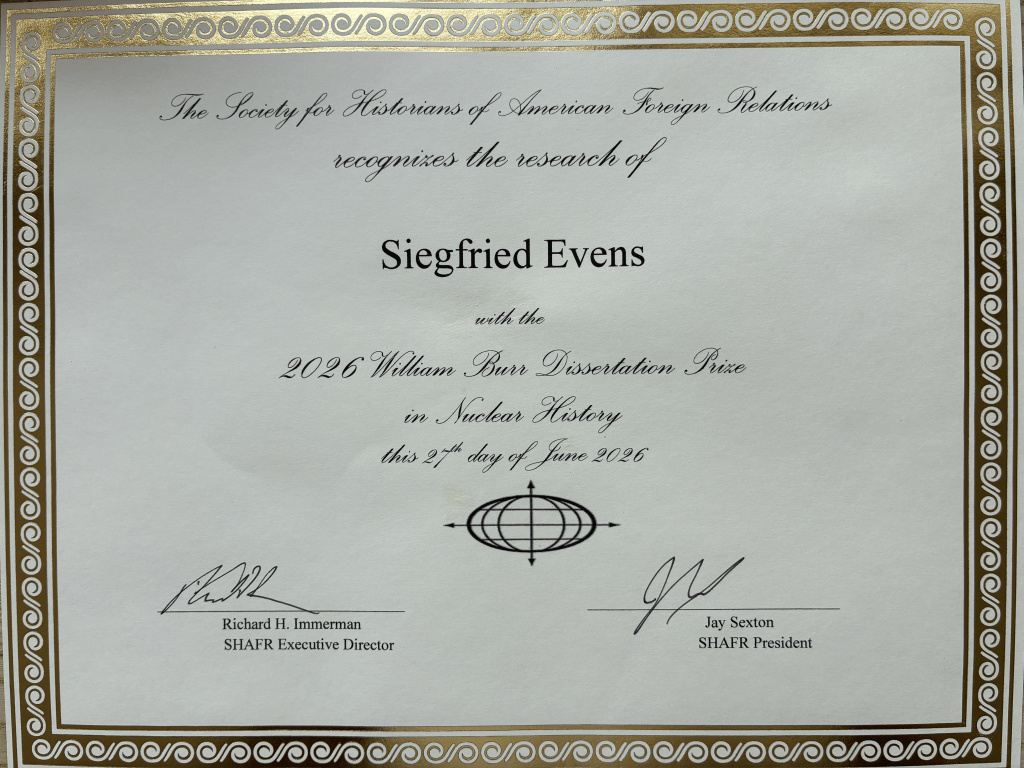
The NUCLEARWATERS team is proud to announce that our project member Siegfried Evens has been named the winner of the first William Burr Dissertation Prize in Nuclear History, awarded jointly by the Society for Historians of American Foreign Relations (SHAFR) and McGill-Queen’s University Press (MQUP). Siegfried defended his PhD thesis in spring 2024, written as part of NUCLEARWATERS and titled “Streams, Steams, and Steels: A Transnational History of Risk Regulation in Nuclear Power Plants (1850-1995).”
Congratulations, Siegfried! How do you feel about getting this prize?
I am very grateful! It’s a wonderful prize, so I could not be happier. Everyone who has done a PhD knows how much work, time, and energy it costs. So it feels great to receive recognition for that work, especially when it comes to SHAFR. And I need to congratulate Michiel Bron as well, with whom I share the prize.
Your PhD thesis is really very ambitious. What were the main challenges with carrying out this research?
I wanted to make some contributions to the literature on nuclear energy in a number of ways, and they indeed turned out to be quite ambitious. Instead of wanting to tell a story about one country, I wanted to use a transnational perspective to study multiple national contexts (US, France, and Sweden) and particularly how actors from those countries interacted and influenced each other. Of course, this brought about the challenge of language, an overload of historical source material, and lots of traveling. In addition, applying our project’s water perspective on nuclear safety was also not easy. Almost everything in a nuclear power plant is about water. So I had to carefully make a selection of a few water and steam technologies I would focus on. Pressure vessels became my favorite!
Lastly, it soon became clear that this was not a story of just the post-war period. Many of the risks related to water in nuclear risk are much older, going back all the way to the Industrial Revolution. Many people thought there was a typo in my thesis title, but the starting date was indeed 1850. But that also meant I needed to include source material about that period as well.
How did the pandemic influence your project?
I was lucky. I was in Paris for field work the last week before most of Europe went into lockdown. So I managed to escape France right on time and came back to Sweden with lots of scans I could work with in the first few months of the pandemic. Meanwhile, many Swedish libraries and archives stayed open during the pandemic. The big problem was getting into the US for field work there. I managed to get on one of the first planes to the US when President Biden lifted the travel ban. But the planning and bureaucracy to make that possible was very difficult. And of course, like for many other PhD students (and people in general) in this period, it was generally not an easy period, being at home so much and not seeing colleagues, students, friends, and family as much as you would want.
What are you especially proud of when it comes to your thesis?
To have been able, together with the whole NUCLEARWATERS team, to study nuclear energy and safety in a very different way – making it about older, more mundane technologies that we rarely associate with nuclear power. Historians have the task, I believe, to look at the broader context and wider timescales. And having done that with nuclear power, a technology we so often hype as new, innovative, and exceptional, has been very rewarding.
And one more thing I am very proud of, is having a PhD defence party in a decommisioned nuclear reactor (R1)!