NUCLEARWATERS is pleased to announce that Achim Klüppelberg, who successfully defended his PhD thesis, “The Nuclear Waters of the Soviet Union: Hydro-Engineering and Technocratic Culture in the Nuclear Industry”, in March 2024, has been awarded this year’s NTM Article Prize for Young Authors. This prize is awarded annually by the NTM Journal of the History of Science, Technology and Medicine, Germany’s leading journal in the field. Achim received the prize for his article “Creating Chernobyl: Technocratic Culture and Everyday Life in Nuclear Ukraine, 1970–1982”, which was part of his doctoral dissertation.
Congratulations, Achim! How do you feel about receiving this prize?
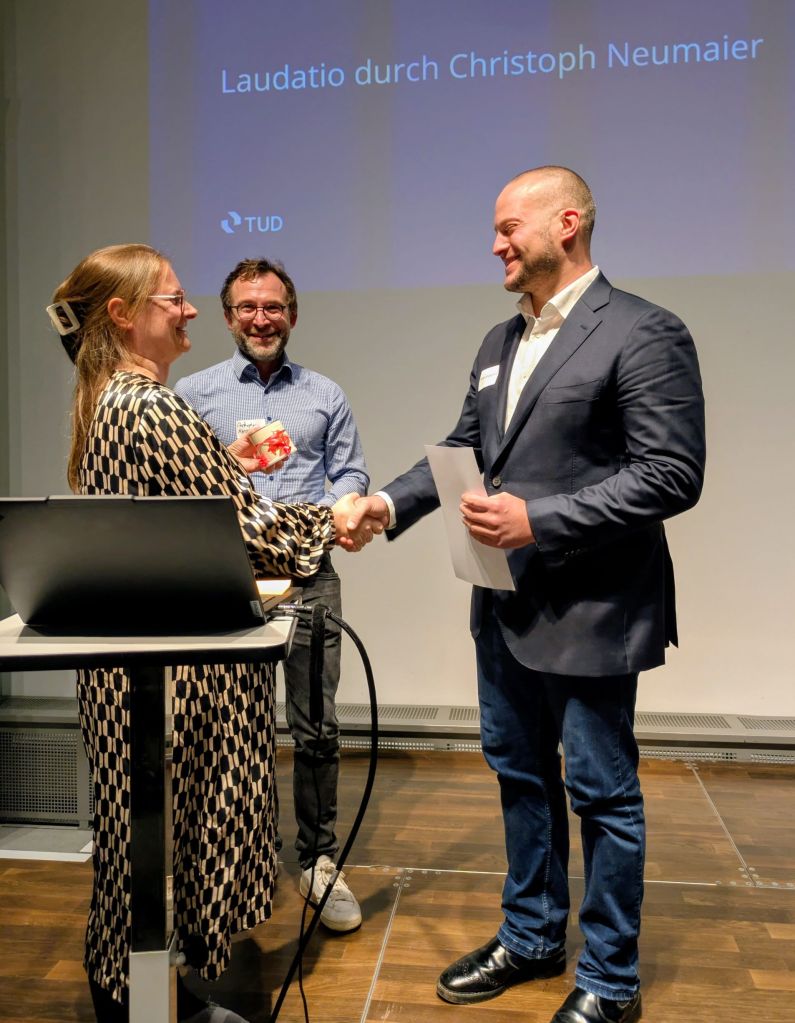
I’m very happy for this recognition of my work, and especially that the members of the prize committee have actually read and engaged with my article. There was a prize ceremony on the occasion of the annual conference of the Gesellschaft für Geschichte der Wissenschaften, der Medizin und der Technik (GWMT), held in Dresden in Germany earlier this autumn. Professor Christopher Neumaier, who headed the prize committee, gave a “laudatio”, explaining why the committee appreciated my article, and I felt humbled and very happy.
Your article examines the early history of the Chernobyl nuclear power plant. Isn’t it strange that so few scholars have done so before?
It’s true that most research on Chernobyl deals with the drama of the accident itself and its tragic aftermath, whereas the early history of the plant has been much less explored. Maybe it is not considered dramatic enough? My article deals to a great extent with “boring” aspects of nuclear construction, including things like leaking water pipes, faulty staircases, and the pouring of concrete. But I’m convinced that we need to study exactly these aspects, as they may reveal deeper structural issues and even lead us to find some parallels to our own societies.
How did you manage to carry out this research at a time of pandemic and war?
It was tough, but I was lucky, because I first managed to visit central Soviet archives in Russia in 2019. Then, in the midst of the pandemic, thanks to generous ERC funding for our project and smooth cooperation with our university library at KTH in Stockholm, I was able to access valuable digitized sources on Chernobyl’s early history including local newspapers and KGB files. When the pandemic receded I was able to travel to Kiev and visit several archives there in autumn 2021. This turned out to be tremendously fruitful and I could probably not have written my article in the absence of those archival sources. The everyday aspects of the story, in particular, would have been much weaker. But I was just in time, because only four months later Russia launched its full-scale invasion of Ukraine and it became impossible to consult Ukrainian archives on site.
What are you especially proud of when it comes to this article?
I’m especially proud of my analytical approach, which is based on the concept of technocratic culture. As I see it, this approach partly explains why the Chernobyl accident happened, and it adds a novel perspective to the literature. I argue that actual Soviet reactor safety was the result of everyday decisions, and that these decisions were taken in a political system that forced actors to cut corners and speed up things in a dangerous way. It’s important for me not to blame the workers. The problem was that the workers could not do their job properly within the framework of the system.

 NUCLEAR WATERS
One thought on “Achim Klüppelberg Receives the NTM Article Prize for Young Authors”